

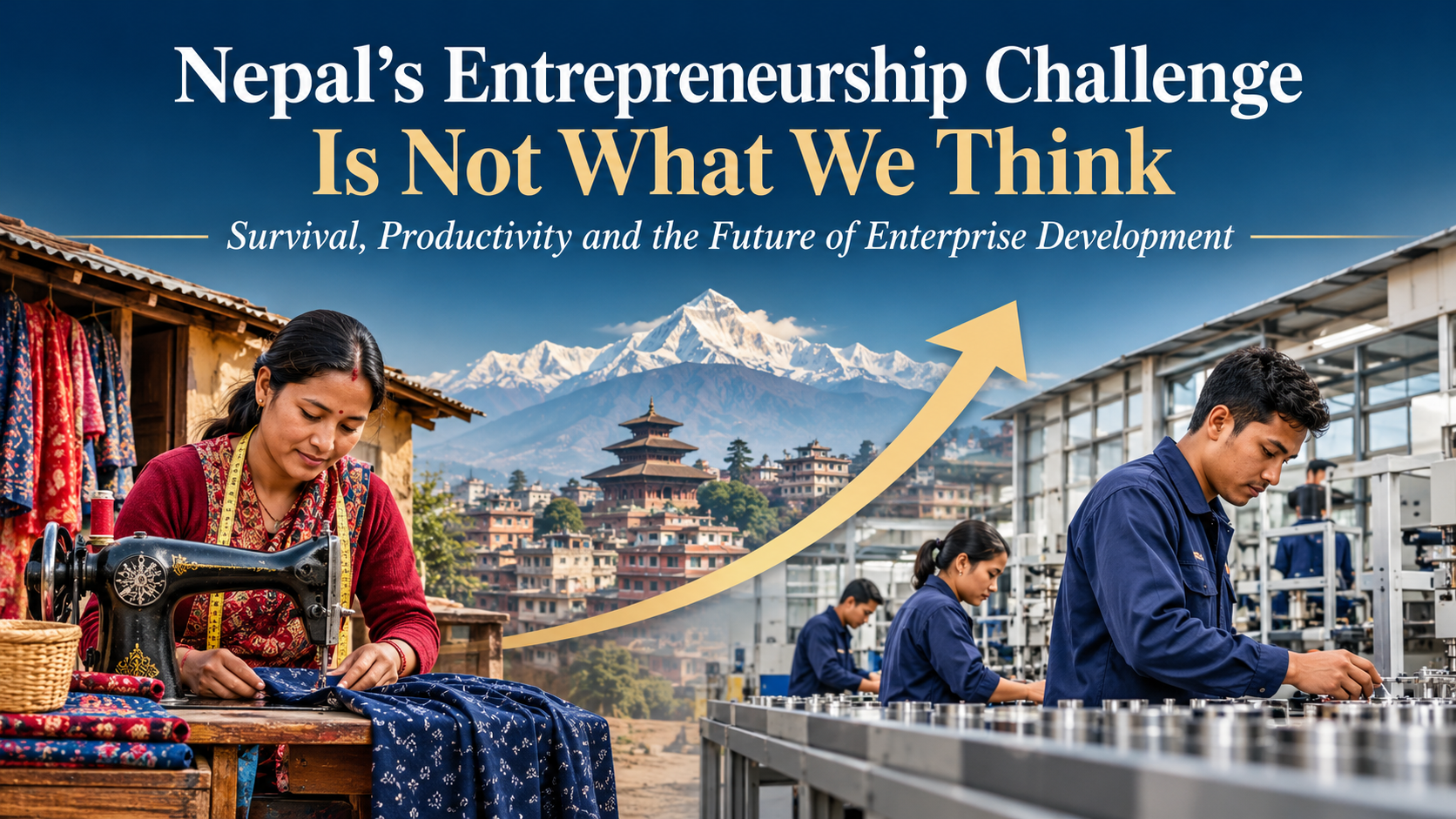
Nepal’s Entrepreneurship Challenge Is Not What We Think
From enterprise survival to productive growth: Why Nepal needs a differentiated approach to entrepreneurship development and a stronger Business Development Service ecosystem
Nepal does not necessarily have a shortage of entrepreneurs. It has a more fundamental challenge: we do not always distinguish between businesses created for survival and enterprises with the potential to become productive, sustainable and growth-oriented.
This distinction matters. Because when every business is treated as a growth business, every entrepreneur is offered more or less the same solution, and the impact of entrepreneurship development remains limited.
A recent World Bank article, What Nepal’s Smallest Businesses Reveal, published on 27 June 2026, offers an important perspective on this challenge. Its findings invite policymakers, financial institutions, development partners and enterprise support organisations to reconsider how Nepal approaches microenterprise development.
1. The reality behind Nepal’s microenterprise economy
Close to 1.5 million Nepalis work in formal and informal microenterprises, outnumbering those employed in small and medium-sized firms combined.
Yet the scale of participation does not necessarily translate into productivity or business growth.
The World Bank highlights several important findings:
- The average informal microenterprise employs approximately 1.5 people.
- Only 8% of informal microenterprises have even one paid worker.
- Nearly half are owned by women, many operating from home because of household and care responsibilities.
- Many generate monthly profits below the minimum wage.
- Formal microenterprises produce approximately six times more output per worker than informal ones.
- Around 68% of formal microenterprises were already formal when they started operating.
- Approximately 22% of informal firms demonstrate genuine productive potential.
These findings reveal that Nepal’s microenterprise sector is not a single, homogeneous category. It represents different economic realities, levels of business capability and prospects for growth.
Some enterprises are primarily livelihood mechanisms. Others are emerging businesses with the potential to improve productivity, generate employment and expand into new markets.
The policy challenge is not simply to create more enterprises. It is to understand what different enterprises need to become more productive and resilient.
2. Not every enterprise needs the same intervention
One of the most important implications of the World Bank findings is the need to move away from a one-size-fits-all approach.
A subsistence-oriented microenterprise may not benefit from additional borrowing if it lacks predictable cash flow, market opportunities or the capacity to manage debt. Its immediate priorities may be basic business skills, income stability, risk protection, childcare support or access to alternative employment opportunities.
An enterprise with genuine growth potential may require something different: improved management, technology adoption, financial discipline, market access, business formalisation and appropriate financing.
Similarly, an established enterprise preparing to scale may need investment readiness, stronger governance, operational systems, skilled human resources and expansion capital.
The distinction is not between successful and unsuccessful entrepreneurs. It is between different enterprise needs, capabilities and opportunities.
This calls for a more deliberate approach to enterprise segmentation and support.
3. Finance matters, but financing readiness matters more
Access to finance remains an important constraint for many Nepali enterprises. However, access to credit alone cannot solve weaknesses in business models, management, market positioning or operational capacity.
A loan is a financial instrument, not a business development strategy.
Before financing, enterprises need to understand their actual capital requirements, repayment capacity, cash-flow patterns, business risks and intended use of funds.
Financial institutions also need better-prepared enterprises, credible business information and stronger mechanisms for assessing business viability.
This is where the relationship between Business Development Services (BDS) and financial services becomes particularly important.
The objective should not be to maximise loan applications or credit disbursement. It should be to improve the quality of financing decisions and ensure that finance contributes to productive economic activity.
The conversation must move from access to finance towards access to appropriate and productive finance.
4. Formalisation is not the same as business growth
Formalisation is important. It can improve access to financial services, markets, institutional opportunities and legal recognition.
However, the World Bank finding that 68% of formal microenterprises were formal from the day they started challenges the assumption that formalisation itself creates productive capacity.
Registration does not automatically improve productivity. Compliance does not automatically create market demand. A business certificate does not guarantee profitability.
Formalisation should therefore be treated as an enabling process, supported by stronger business fundamentals, rather than an end in itself.
Enterprises need to understand why formalisation matters, what obligations it creates and how it can contribute to their long-term business objectives.
The focus should be on meaningful formalisation that supports enterprise development, not registration figures alone.
5. The missing link: A stronger Business Development Service ecosystem
If enterprise needs are different, the support system must also be different.
This is where Business Development Service Providers (BDSPs) can play a much more strategic role in Nepal’s entrepreneurship ecosystem.
BDSPs should not be viewed merely as training organisations, business plan writers, loan facilitators or project implementation partners. Their role should extend across the enterprise development journey, helping businesses diagnose their challenges, build capabilities, access appropriate resources and improve performance.
A professional BDSP ecosystem can connect entrepreneurs with the right expertise, financial institutions, markets, technology, institutional support and development opportunities.
Its contribution can be organised around five interconnected functions:
1. Diagnose: Understand before intervening
Assess the enterprise’s business model, financial position, management capacity, market conditions, operational constraints, risks and development potential.
2. Prepare: Build the foundations for improvement
Strengthen business planning, financial management, record-keeping, compliance, operational systems, governance and financial readiness.
3. Connect: Link enterprises with relevant resources
Facilitate appropriate connections with banks and financial institutions, markets, technology providers, professional experts, government programmes and development partners.
4. Improve: Support implementation and performance
Provide practical advisory services, coaching and follow-up support to help enterprises address identified weaknesses and implement business improvements.
5. Track: Measure what changes
Monitor progress through meaningful indicators such as productivity, profitability, business resilience, market access, investment readiness, employment and business sustainability.
This approach positions BDSPs as an important institutional bridge between enterprise realities and the resources available within the wider business ecosystem.
However, this requires more than increasing the number of registered service providers. Nepal needs capable and accountable BDSPs with professional standards, appropriate expertise, geographical reach and a clear focus on measurable enterprise outcomes.
The effectiveness of a BDSP should not be measured only by the number of entrepreneurs trained, business plans prepared, registrations completed or loan applications facilitated. It should also be measured by what improves in the businesses they support.
6. A differentiated enterprise support model
A more effective enterprise development system should recognise that businesses progress through different stages and require different forms of support.

This is a proposed framework for translating the evidence into practical enterprise support. It should not be interpreted as a classification directly prescribed by the World Bank study.
The important principle is that support should follow enterprise needs and potential, rather than forcing every business into the same programme structure.
7. Entrepreneurship development must move beyond programme outputs
Nepal has invested in entrepreneurship training, startup promotion, concessional financing, business incubation, enterprise development programmes and institutional support.
These interventions have value. But their effectiveness should be assessed through the changes they create in enterprises, not simply the activities they deliver.
The ecosystem needs to reconsider some familiar measures of success:
- From the number of people trained to the capabilities they actually develop.
- From the number of businesses registered to the quality and sustainability of those businesses.
- From the volume of loans facilitated to the productive use of finance.
- From the number of business plans prepared to the number of businesses that implement and improve them.
- From programme completion to measurable enterprise performance.
- From isolated interventions to continuous business development support.
This also requires stronger coordination among government agencies, financial institutions, BDSPs, business associations, academic institutions, development partners and the private sector.
No single institution can address the full range of constraints faced by Nepal’s micro, small and medium enterprises.
A connected enterprise development ecosystem is therefore not optional. It is essential.
8. The larger challenge is economic opportunity
There is another important dimension to this discussion.
The prevalence of informal and subsistence-oriented microenterprises cannot be understood only as an entrepreneurship issue. It also reflects limited formal employment opportunities, barriers to economic mobility and the need for households to generate income through self-employment.
Not every informal business is waiting to become a larger company. Some are providing essential livelihoods in circumstances where alternative economic opportunities are limited.
Therefore, the objective should not be to push every microenterprise towards expansion, borrowing or formalisation.
For some, the priority is improved livelihood security and resilience. For others, it is the transition towards more productive and sustainable business activity.
At the broader economic level, improvements in the business environment, infrastructure, financial access, investment conditions and market opportunities remain essential to creating an environment in which enterprises can grow and productive employment can expand.
Enterprise-level support and economy-wide reforms must work together.
9. Rethinking the future of enterprise development in Nepal
The World Bank findings offer an opportunity to reconsider how Nepal defines entrepreneurship success.
The question should no longer be simply how many entrepreneurs we create, train, register or finance.
We should ask:
- Are enterprises becoming more productive?
- Are business owners improving their financial and management capabilities?
- Is finance being used for viable and productive purposes?
- Are enterprises accessing better markets and technologies?
- Are more businesses becoming resilient and sustainable?
- Are growth-oriented enterprises generating quality employment?
- Are support programmes reaching the enterprises that need them most?
Answering these questions requires better enterprise-level information, stronger institutional coordination, professional BDSPs and a commitment to measuring long-term outcomes.
A final perspective
Nepal does not need to treat every microenterprise as a startup, every entrepreneur as a potential borrower or every informal business as a future growth company.
It needs an enterprise development system that understands the difference.
A system where financial institutions finance responsibly, BDSPs build enterprise capabilities, development partners support evidence-based interventions, policymakers create enabling conditions and entrepreneurs receive services appropriate to their business realities.
The next phase of entrepreneurship development in Nepal should be built around three shifts:
- From generic support to diagnosis-led enterprise development.
- From access to finance to productive and responsible finance.
- From counting programme outputs to measuring enterprise outcomes.
Ultimately, the role of a strong Business Development Service ecosystem is not to make every business bigger. It is to help every enterprise become better positioned for its intended purpose, whether that means securing a livelihood, improving productivity, building resilience or achieving sustainable growth.
Data should shape the intervention. Enterprise reality should shape the policy. Professional business development services should connect the two. And measurable outcomes should define success.
Source and further reading: World Bank, What Nepal’s Smallest Businesses Reveal, June 27, 2026. The article is based on Survival or Growth? Nepal’s Microenterprise Landscape and the Case for a Differentiated Policy Approach.
Read the underlying World Bank study
#Nepal #Entrepreneurship #MSMEs #EnterpriseDevelopment #BusinessDevelopment #FinancialInclusion #SMEs #EconomicDevelopment #EntrepreneurshipEcosystem #NepalBusiness