

Nepal’s Geography of Capital: Who Gets to Finance the Future?
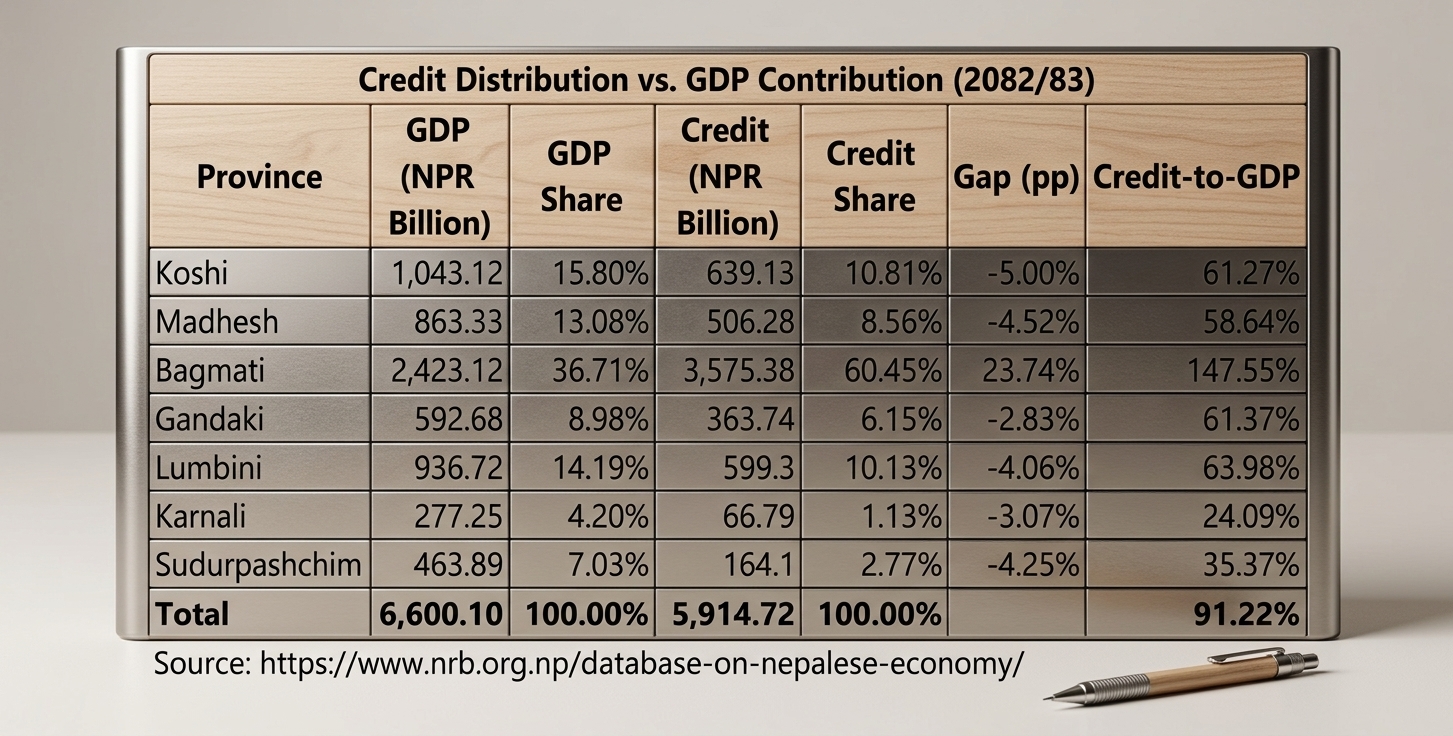
Bagmati produces 36.7% of Nepal’s GDP but accounts for 60.5% of recorded bank credit. Karnali produces 4.2% of GDP but accounts for just 1.1% of credit.
These figures reveal more than a difference in financial activity. They raise a fundamental question about Nepal’s development trajectory: where capital flows, what it enables, and which parts of the country are positioned to grow.
Capital does not merely follow economic opportunity. By financing businesses, infrastructure, technology and productive assets, it also helps create that opportunity.
This is why Nepal’s geographic distribution of bank credit deserves greater attention in the national conversation on economic transformation, federalism and inclusive growth.
The imbalance is difficult to ignore
The FY 2082/83 figures present a striking contrast between provincial economic output and recorded credit distribution.

Bagmati’s share of recorded credit exceeds its GDP share by 23.74 percentage points. Every other province has a lower share of recorded credit than its contribution to national output.
This does not establish that credit is unfairly allocated. GDP and credit measure different things, and provincial economies differ in their financing needs, economic structures and investment opportunities.
But the magnitude of the disparity raises a question that cannot be answered by looking at credit totals alone.
Is Nepal’s financial system enabling new centres of economic growth, or primarily serving the centres where economic activity is already concentrated?
The issue is not where capital is concentrated. It is what that concentration produces.
Bagmati’s position is understandable in important respects. Kathmandu is Nepal’s principal centre of corporate activity, administration and financial services. Many large businesses, financial institutions and national headquarters are located there.
Its economic importance should not be diminished, and its businesses should not be penalised for their success.
The development challenge is different: whether the advantages of established commercial centres make it progressively harder for viable enterprises elsewhere to access the finance required to compete.
Businesses with established banking relationships, reliable financial records, conventional collateral and predictable cash flows are generally easier to assess. Enterprises in emerging markets may face higher transaction costs, weaker infrastructure, limited credit histories and financing products poorly suited to their circumstances.
This can create a reinforcing cycle. Established markets attract finance because they already have bankable businesses. Those businesses expand, deepen commercial networks and attract further investment. Meanwhile, promising enterprises in less-developed markets may struggle to secure the initial capital needed to establish a track record.
The result can be a widening gap between places that already attract investment and places that need investment to unlock their potential.
When access to capital depends heavily on the strength of an existing market, economic geography can become self-reinforcing.
That is the possibility Nepal should investigate.
Financial inclusion must lead to productive inclusion
Opening bank accounts, expanding digital payments and increasing access to basic financial services are important achievements. But access to a financial system is not the same as access to the capital required to build a business.
Consider the difference between a farmer who can save through a bank and one who can finance cold storage. Between a small manufacturer that can make digital payments and one that can purchase modern machinery. Between a tourism entrepreneur who has identified a viable opportunity and one who can secure financing to develop it.
The distinction is between participating in the financial system and using finance to expand productive capacity.
Of course, credit cannot solve every development constraint. Roads, electricity, skills, market access and reliable infrastructure remain essential. Nor should banks be expected to finance every business idea regardless of its commercial viability.
The real question is whether otherwise viable investments are being held back by avoidable financial barriers.
Are collateral requirements excluding businesses with credible cash flows? Are lenders equipped to assess agricultural value chains and smaller enterprises? Are transaction costs discouraging lending in remote markets? Are entrepreneurs receiving the support needed to become investment-ready?
These are practical questions with practical answers. But they require evidence at the enterprise and local-market level.
From provincial disparities to a national investment agenda
Nepal should resist the temptation to respond to these figures with arbitrary provincial credit quotas. Equal shares of credit would neither reflect differences in economic needs nor guarantee productive investment.
A more effective response would focus on three priorities.
1. Make the geography of investment visible.
Nepal Rastra Bank should strengthen reporting on where loans are booked, where the financed activities take place and which types of enterprises receive credit. Provincial and district-level information on lending purposes, borrower characteristics, new disbursements and outstanding balances would help distinguish genuine financing gaps from differences in reporting practices.
Without this evidence, policymakers cannot reliably identify the constraints they need to address.
2. Make viable investment easier to finance.
Financial institutions, provincial governments and development partners should identify commercially credible enterprises that remain underserved and determine why they cannot obtain suitable finance.
Depending on the evidence, responses could include credit guarantees, value-chain financing, working-capital facilities, improved enterprise records and technical assistance. Such interventions should address demonstrable market failures and mobilise additional private investment, rather than subsidise lending that would have happened anyway.
3. Measure what finance makes possible.
Success should not be defined by how much additional credit reaches a province. It should be assessed by whether viable underserved enterprises gain access to finance, whether private investment increases, whether productivity and employment improve, and whether loans remain sustainable.
Clear baselines, transparent targets and independent evaluation can help distinguish genuine development impact from a simple increase in lending volumes.
For development partners, this offers a practical opportunity to move beyond isolated financing programmes towards interventions that strengthen local financial markets and generate measurable economic outcomes.
Federalism needs an economic dimension
Nepal’s federal transition changed the distribution of political authority. Its economic promise also depends on whether businesses and communities can access the resources required to build productive local economies.
Provincial and local governments cannot create commercially viable enterprises through policy declarations alone. They need to help establish the conditions for investment through infrastructure, skills, market connections and a credible pipeline of projects.
Banks need better information and appropriate tools to assess borrowers beyond established commercial centres. Regulators need evidence that distinguishes genuine credit constraints from differences in economic structure. Development partners need to support interventions that address identifiable market failures and demonstrate additional impact.
This is not a call to move capital away from Bagmati simply because its share is high. It is a call to understand whether capital can support more productive activity across Nepal without compromising financial discipline.
The distinction is important. Inclusive growth does not require every province to receive the same amount of finance. It requires viable economic opportunities to have a realistic chance of attracting it.
The question Nepal should be asking
The provincial figures are a starting point, not a complete diagnosis. Credit recorded in one province may finance activities elsewhere, and a low credit-to-GDP ratio does not automatically prove that businesses are underserved.
These limitations make better data more important, not less.
Nepal needs to understand how much of its geographic credit concentration reflects the location of borrowers and financial institutions, how much reflects genuine differences in financing demand, and how much points to viable investment being held back by structural barriers.
The answers should guide the response.
If infrastructure is the binding constraint, finance alone will not solve it. If viable businesses lack acceptable collateral, risk-sharing mechanisms may help. If enterprises are not investment-ready, business development support may be more effective. If lending data misrepresent where capital is used, reporting must improve.
The objective is to match the intervention to the problem.
Nepal’s next phase of economic development will depend not only on how much capital its financial system mobilises, but also on how effectively that capital enables productive opportunity across the country.
The central question is therefore not whether Bagmati receives too much or other provinces receive too little.
It is this:
How many viable businesses, productive investments and future jobs are being lost because Nepal has not yet built a financial system capable of recognising opportunity wherever it exists?
That is a question for banks, regulators, governments, development partners and the private sector alike. Answering it with better evidence and acting on what that evidence reveals could make geographic inclusion a practical investment agenda rather than an aspiration.