

Nepal’s Missing Reform Layer: We Don’t Need More Laws. We Need Navigators – BDSPs
Laws Exist, But Navigation Fails
When the World Bank released its Business Ready 2025 assessment covering 101 economies, it quietly delivered a message Nepal needs to hear. Business climates do not improve simply because laws exist. They improve when businesses can actually navigate the system efficiently.
Nepal does not lack rules. What we lack is structured support.
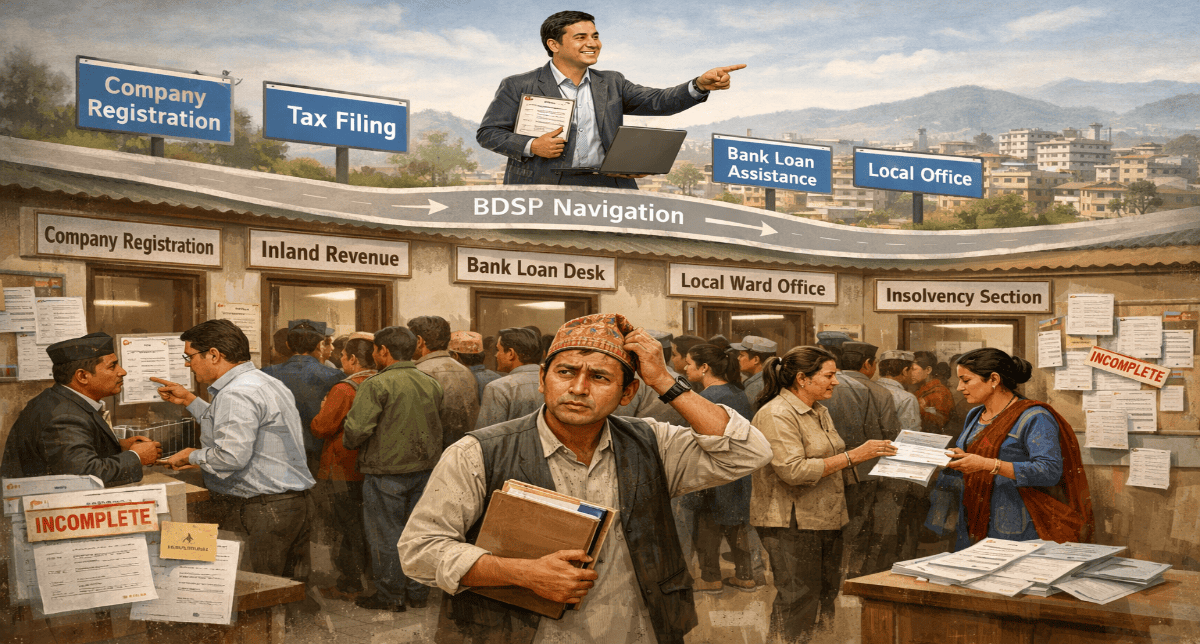
From Biratnagar to Nepalgunj, from Butwal to Kathmandu, entrepreneurs face the same frustration. Forms are returned for minor gaps. Documentation is incomplete because guidance is unclear. Loan proposals fail not for lack of effort but because financial plan are weak. Insolvency mechanisms exist on paper, yet restructuring rarely happens. Digital systems are being introduced, but they rarely talk to each other.
The problem is not the law. The problem is navigation. Behind this friction lies a missing layer that could make all the difference. We need a formally recognized and structured network of Business Development Service Providers.
The Reality on the Ground
Advisory support already exists in Nepal. Chartered Accountants, Registered Auditors, former bankers, independent consultants, and even informal document helpers provide guidance every day.
But the system is scattered. There is no national accreditation framework, no public registry of qualified professionals, no clear service standards, and no structured link to financial institutions or government programs.
Some entrepreneurs get excellent guidance. Others rely on trial and error, which leads to rejected files, delayed approvals, and failed credit applications. We are not lacking advisors. We are lacking an advisory system.
Policy Strength Does Not Equal Practical Ease
Nepal’s rules are strong, but businesses still struggle with permits, credit applications, insolvency procedures, and digital compliance. Digital systems exist, but interoperability is limited.
Countries that improved their business environment did not just pass better laws. They built advisory ecosystems, accredited professionals, connected them to digital systems, and embedded them into government programs. They created navigators. Nepal has yet to do this.
Why BDSP Recognition Matters
Repeatedly rejected documentation is not just inconvenient. It wastes time and resources. Poorly structured credit proposals reflect systemic information gaps, not SME weakness. Underused insolvency mechanisms signal advisory capacity gaps.
Recognizing and structuring BDSPs is not about creating a lobby group. It is about reducing costs for businesses and the system as a whole.
Accredited BDSPs could:
- Standardize documentation and reduce rejection rates
- Prepare structured financial plan aligned with bank requirements
- Support restructuring before loans turn non-performing
- Assist with digital compliance processes
This strengthens regulatory outcomes, improves credit discipline, enhances transparency, and makes existing laws work in practice.
The Reform We Rarely Discuss
Reform does not always mean drafting new legislation. Sometimes it means building the professional infrastructure that allows existing laws to function effectively.
A national BDSP accreditation framework, a public registry of certified providers, minimum service standards, digital filing rights, and structured collaboration with financial institutions would be a game-changer. This is not deregulation. It is strengthening the system in a practical way.
A National Opportunity
Nepal does not lack intent. We pass laws, draft strategies, and speak about investment climate reform. Yet entrepreneurs still ask: “Who will guide me through this system?”
A business environment is not only about what is written in Acts and directives. It is about whether a small enterprise owner in Chitwan or Dhangadhi can navigate compliance without fear, delay, or confusion.
BDSPs can be that bridge. Nepal does not need more laws. Nepal needs navigators. Nepal needs a recognized, accountable, and integrated BDSP ecosystem to help every entrepreneur turn rules into real opportunities.
The missing layer of reform is professionalized support, and Nepal is ready for that step.