

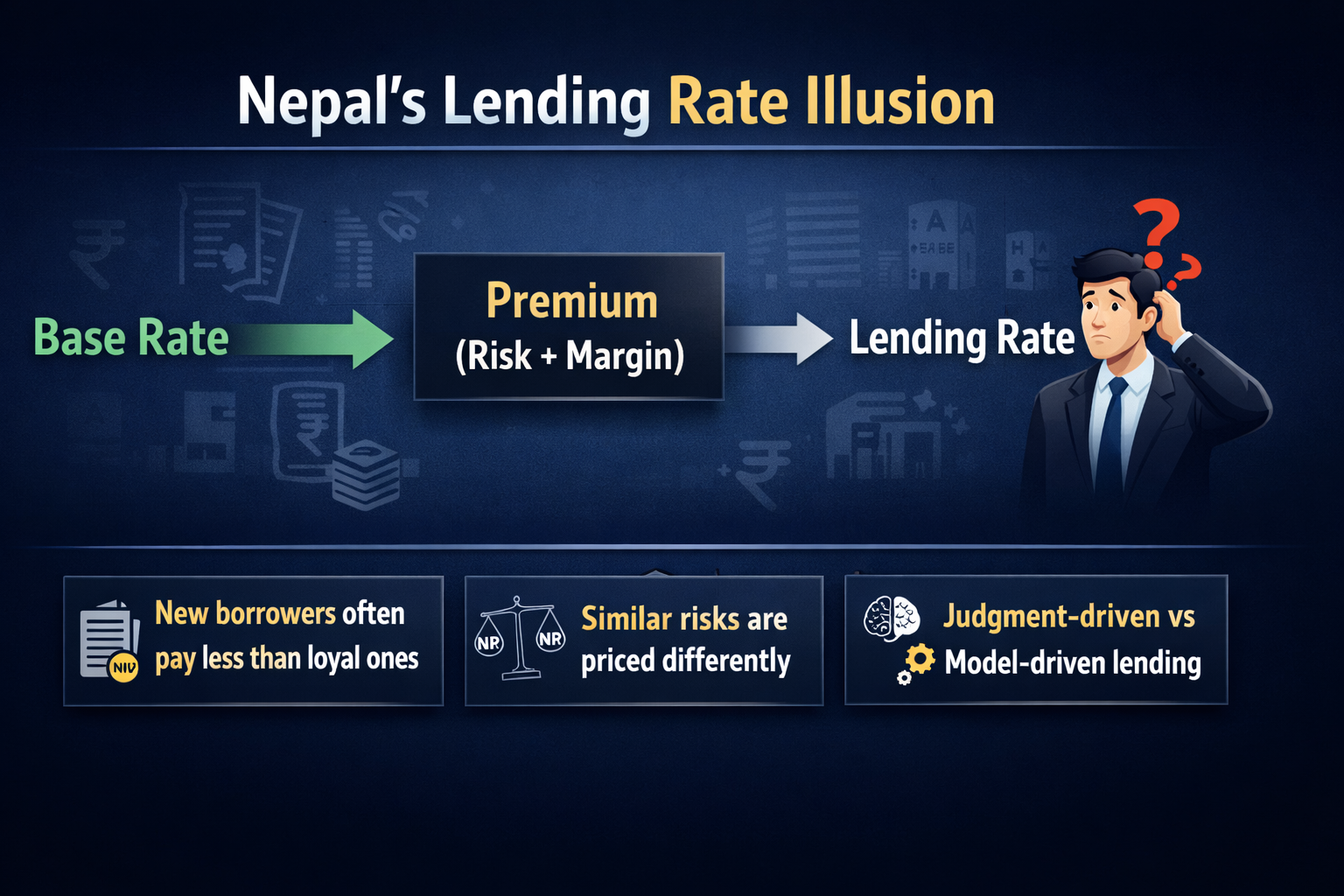
Nepal’s Lending Rate Illusion
When “Base Rate + Premium” Becomes a Black Box —and why new borrowers often get better deals than loyal ones
Nepal’s transition to a Base Rate + Premium lending framework—under the guidance of Nepal Rastra Bank—was designed to fix a broken past. It promised transparency, discipline, and a shift toward risk-based pricing.
On paper, the system looks modern. In practice, one critical component remains opaque: the premium.
The base rate is visible. The premium decides everything.
The Promise vs Reality
The reform was meant to follow a simple global logic: benchmark + spread = lending rate
But in Nepal:
· The benchmark is regulated
· The spread is discretionary
And that discretionary space is where opacity thrives.
Borrowers are told:
· “Your rate is Base Rate + 3%”
But rarely:
· Why 3% instead of 2% or 5%
And that “why” is the entire story.
Is the Premium Really a Black Box?
Technically, no. Practically, very close.
Banks consider:
· Default risk (repayment capacity)
· Liquidity and recovery conditions
· Loan tenure
· Sector exposure
But these factors are rarely:
· Standardized
· Clearly disclosed
· Auditable from a borrower’s perspective
What should be risk-based pricing often feels like negotiated pricing.
When pricing logic is invisible, trust becomes negotiable.
The Collateral Comfort Zone
Despite policy intent, Nepal has not fully transitioned to cash-flow-based lending.
Premiums still lean heavily on:
· Land and building valuation
· Personal guarantees
· Relationship history
This creates a structural distortion:
· Asset-rich but low-productivity borrowers get cheaper loans
· High-potential but asset-light entrepreneurs pay more
That is not risk pricing. That is risk avoidance.
Same Risk, Different Price
In mature systems, similar borrowers converge toward similar rates.
In Nepal:
· Two comparable SMEs can face very different premiums
· Even within the same bank, pricing varies across branches
This is not just flexibility—it signals something deeper:
The system is still personality-driven, not model-driven.
The Paradox: New vs Existing Borrowers
A striking anomaly is emerging in today’s liquidity-rich environment.
Banks are:
· Offering new borrowers loans near the base rate to gain market share
· Continuing to charge existing borrowers higher premiums—even with proven repayment records
Illustration:
· Existing borrower → 5% + 3.5% = 8.5%
· New borrower → 5% + 1% = 6%
The paradox is clear: The proven borrower pays more than the untested one.
Why this happens:
· Aggressive credit growth strategies
· Switching inertia among existing clients
· Incentive structures that reward new disbursement, not portfolio fairness
The premium, therefore, becomes not just a risk tool—but a strategic pricing lever.
The Policy Transmission Gap
When Nepal Rastra Bank adjusts monetary policy:
· Base rates adjust slowly due to deposit stickiness
· Premiums often remain unchanged
The result:
· Delayed transmission
· Partial impact on borrowers
Policy signals weaken before they reach the real economy.
Why Banks Defend the System
Banks are not acting irrationally.
They operate within constraints:
· Weak credit information systems
· Lengthy legal recovery processes
· Economic volatility
· Informal financial behavior
In this environment, the premium becomes:
A buffer against uncertainty the system has not yet solved.
The Real Cost of Opacity
This is not just a technical flaw—it shapes the economy:
· Businesses struggle to predict borrowing costs
· Financial planning becomes conservative
· Credit demand weakens during uncertainty
· Trust in the financial system erodes
Over time, this directly affects:
· Investment decisions
· SME growth
· Financial inclusion
What Needs to Change
Not more regulation—better clarity.
1. Structured Premium Disclosure Borrowers should see:
· Credit risk contribution
· Tenure impact
· Collateral adjustments
2. Standardized Risk Bands
· Low / Medium / High risk categories
· Indicative premium ranges
3. Stronger Credit Infrastructure Shift toward data-driven lending:
· Cash flow analysis
· Digital transaction history
· Sectoral benchmarks
4. Internal Pricing Discipline
· Reduce branch-level subjectivity
· Strengthen model-based pricing frameworks
Final Reflection
Nepal’s lending rate system is not broken. It is unfinished.
· The base rate brought transparency
· The premium still operates in shadow
· And today, new borrowers can pay less than proven ones
Until the premium becomes explainable, consistent, and fair, lending will remain only partially transparent.
And in finance, partial transparency is simply a more sophisticated form of opacity.